5 answers to your biggest body fat percentage questions
Learn the difference between total weight and body fat, why men and women have different healthy ranges, and how to accurately measure your body composition at home using just a flexible tape measure.
Jul 7, 2026 5 min read
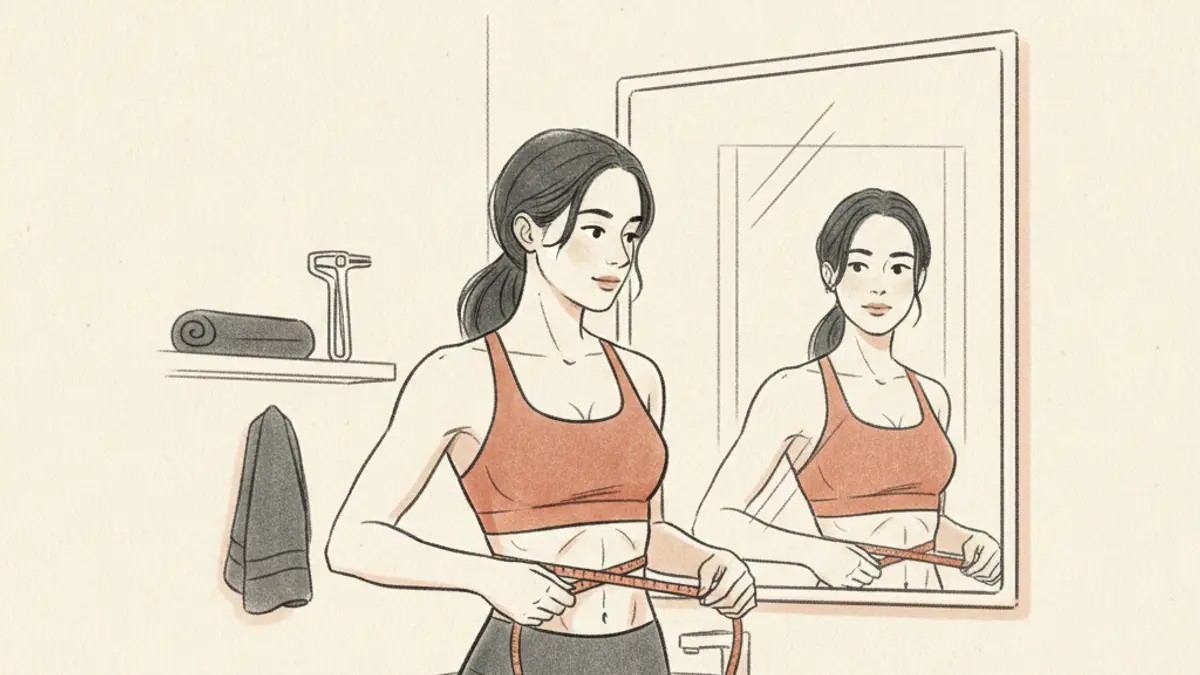
When you step on a standard bathroom scale, the number staring back at you only tells part of the story. A basic scale measures your total body mass, but it cannot tell the difference between three pounds of muscle and three pounds of fat. Body mass index (BMI) is often used to gauge health, but it only looks at your height and weight. A heavy athlete might be classified as overweight by BMI standards, even if their body fat is incredibly low.
Body fat percentage skips that guesswork. It isolates exactly how much of your overall weight is fat tissue versus lean mass—things like muscle, bone, and water. Because it tracks actual body composition rather than just gravity’s pull, it is a highly useful metric for health and fitness. It also generates plenty of questions. Here are direct answers to five common inquiries about the math, the biology, and the measurement process.
1. What is a healthy body fat percentage?
There is no single ideal number for everyone. Instead, there are ranges of healthy percentages based on your biological sex and fitness goals. The American Council on Exercise (ACE) breaks these down into five categories.
| Category | Men | Women |
|---|---|---|
| Essential fat | 2–5% | 10–13% |
| Athletic | 6–13% | 14–20% |
| Fitness | 14–17% | 21–24% |
| Average | 18–24% | 25–31% |
| Obese | 25%+ | 32%+ |
Most healthy adults fall into the fitness or average categories. The athletic category represents people who carry very little body fat, typically seen in competitive sports and endurance athletics. A percentage in the obese category indicates a high level of excess body fat, which correlates with higher risks for cardiovascular and metabolic conditions.
2. Why do men and women have different body fat standards?
Looking at the table above, the percentage ranges for women are consistently higher than those for men. This is a strict biological necessity because women naturally carry more essential fat.
Essential fat is the absolute minimum amount of fat required for basic physical and physiological health. Your body uses it to protect internal organs, store energy, and regulate temperature. For men, this baseline sits around 2 to 5 percent. For women, it is between 10 and 13 percent.
This difference mostly comes down to hormones and reproductive function. Fat deposits in the hips, thighs, and breasts are normal and required for female health. Since a woman’s baseline for essential fat is roughly eight percentage points higher than a man’s, all of the corresponding fitness and health categories are shifted upward by a similar amount to account for that foundational difference.
3. How can I calculate my body fat at home?
You do not need a pricey lab appointment to estimate your body composition. The most accessible home measurement is the US Navy circumference method. Developed by researchers in 1984, this approach uses a few tape measure readings to estimate your body fat percentage.
For men, the formula requires height, neck circumference, and waist circumference. For women, it requires height, neck, waist, and hip measurements. The underlying math finds the difference between your circumferences and runs them through a logarithmic equation.
To see how this works, consider a 180-pound man who is 70 inches tall, with a 15-inch neck and a 32-inch waist. By applying the US Navy formula, his estimated body fat is roughly 14.7 percent.
Once you know your percentage, you can figure out your exact tissue breakdown in pounds. Just multiply your total weight by your body fat percentage to find your fat mass. In the example above, 180 pounds × 14.7 percent yields about 26.5 pounds of fat. Subtracting that from the total weight (180 − 26.5) leaves 153.5 pounds of lean mass. That lean mass includes your bones, muscles, blood, and organs.
4. How accurate is the tape measure method?
People often wonder if home methods actually work. The US Navy method is surprisingly effective for a tool that just requires a flexible tape measure.
For most healthy adults, this method predicts body fat within about 3 to 4 percentage points of a DEXA scan. A DEXA scan (dual-energy x-ray absorptiometry) is a medical-grade imaging test widely considered the gold standard for analyzing body composition.
Still, the tape measure method is a practical screening tool, not a clinical diagnostic measurement. It loses accuracy at the physical extremes. For instance, highly muscular individuals with thick waists might get an artificially high reading. On the flip side, someone who is very thin but carries a disproportionate amount of visceral fat—the hidden fat stored deep inside the belly—might get a reading that is too low.
For the average person, the real value of the tape measure method is tracking progress over time. If your waist measurement shrinks while your weight stays the same, you are losing fat and gaining lean mass, even if the absolute percentage is slightly off.
5. How do I measure my body correctly?
Since the US Navy formula relies entirely on circumferences, poor measuring technique ruins the calculation. Use a flexible fiberglass or cloth measuring tape. Keep the tape perfectly horizontal, stand straight, breathe normally, and resist the urge to suck in your stomach.
Here is exactly where to measure:
- Neck: Measure just below the larynx, commonly known as the Adam’s apple. Keep the tape flat against the skin without pulling it tight enough to leave an indentation.
- Waist (Men): Measure horizontally around your abdomen at the exact level of the navel.
- Waist (Women): Measure at the narrowest point of your torso. This is usually halfway between the bottom of the rib cage and the belly button.
- Hips (Women only): Measure around the widest point of your hips and buttocks.
Taking these measurements at the same time of day under the same conditions will give you the most reliable data. First thing in the morning, before eating or drinking, is usually best.
Ready to find out your numbers? Grab a tape measure, note your circumferences, and enter them into the Body Fat Percentage Calculator.