How to find missing sides and angles in 4 real-world scenarios
Learn how to use the law of sines and law of cosines to find missing sides and angles. We explore four practical scenarios, from building a custom deck to locating a forest fire, to show how trigonometry solves everyday measurement problems.
Sep 18, 2026 5 min read
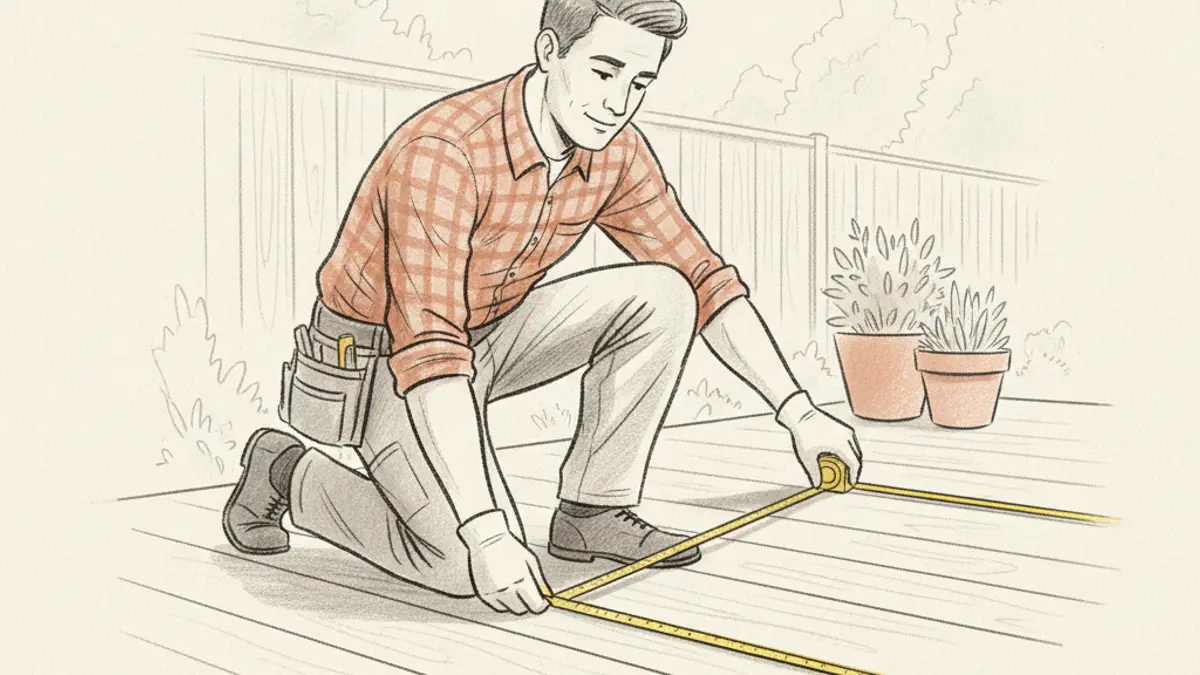
You will frequently need to measure a triangular space but find yourself unable to physically reach every corner or edge. Fortunately, triangles are mathematically predictable. As long as you know three measurements—and at least one of them is a side length—you can figure out the rest.
If you have three sides, two sides and an angle, or two angles and a side, the math fills in the blanks. We use two main rules to do this. The law of sines compares the ratio of a side length to its opposite angle. The law of cosines acts like an expanded version of the Pythagorean theorem, calculating a missing side or angle when you know the other sides.
Before walking through a few real-world examples, here is a quick guide to which rule applies to your measurements.
| Known Values | Shorthand | Primary Rule |
|---|---|---|
| Three sides | SSS | Law of cosines |
| Two sides, angle between them | SAS | Law of cosines |
| Two angles, any side | AAS or ASA | Law of sines |
| Two sides, one opposite angle | SSA | Law of sines |
Example 1: Building a Custom Deck (SSS)
Let’s say you are building a custom wooden deck in the corner of a backyard. You have staked out the boundaries and measured the three outer edges: 12 feet, 15 feet, and 20 feet.
To buy the right amount of decking and know exactly how to cut your border joints, you need the area and the interior angles. Because you know all three sides (a Side-Side-Side, or SSS triangle), the law of cosines will find the angles. Heron’s formula—a geometric rule for finding the area of a triangle using only its side lengths—will handle the square footage.
First, the perimeter is simple addition. Adding 12, 15, and 20 gives you 47 feet of railing needed to enclose the deck.
Next, Heron’s formula shows the area is approximately 89.66 square feet. This tells you exactly how many boards to order so you do not come up short.
Finally, the law of cosines gives you the angles for your cuts. The angle opposite the longest 20-foot side is 94.94 degrees. The angle opposite the 15-foot side is 48.35 degrees, and the angle opposite the 12-foot side is 36.71 degrees.
Example 2: Surveying Across a Lake (SAS)
Surveyors constantly need to measure distances across obstacles they cannot just walk over, like a lake or a steep ravine. They solve this by forming a virtual triangle over the landscape.
Imagine a surveyor standing on the shore at Point C. They have a clear line of sight to a tree on their left (Point A), which they measure to be 40 meters away. They look to a boulder on their right (Point B) and measure it at 60 meters away. They then measure the angle between those two lines of sight and find it is 75 degrees.
They need the straight-line distance across the water from the tree to the boulder. Since they have two sides and the included angle between them (Side-Angle-Side, or SAS), the law of cosines is the right tool for the job.
The math reveals the distance from the tree to the boulder is exactly 62.91 meters. The remaining angles are 67.10 degrees at the tree and 37.90 degrees at the boulder. If they also needed the surface area of this specific triangular slice of land and water, it comes out to 1,159.1 square meters. You could verify this quickly with a dedicated Area calculator.
Example 3: Locating a Forest Fire (ASA)
Fire watchtowers use triangulation to pinpoint smoke. Suppose Tower A and Tower B sit exactly 10 miles apart along a straight mountain ridge.
Both spot a plume of smoke in the distance. The ranger in Tower A measures the angle of the smoke relative to the ridge at 80 degrees. The ranger in Tower B measures the angle from their end at 65 degrees.
To send a helicopter, dispatch needs to know the exact distance from each tower to the fire. This is an Angle-Side-Angle (ASA) scenario, which requires the law of sines.
Because the interior angles of all flat triangles add up to exactly 180 degrees, finding the third angle at the fire itself is just subtraction: 180 − 80 − 65 = 35 degrees.
From there, the law of sines calculates the distances. The fire is 15.80 miles from Tower A and 17.17 miles from Tower B.
Example 4: Verifying a Square Corner (SSS)
One of the most common shortcuts in construction is the 3-4-5 rule, used to check if a corner is perfectly square, meaning it sits at exactly a 90-degree angle.
If a carpenter is framing two intersecting walls, they can mark a point 3 feet down one wall and 4 feet down the other. If they stretch a tape measure between those two marks and the diagonal distance is exactly 5 feet, the corner is perfectly square. This is a practical, everyday application of solving a Side-Side-Side triangle.
With sides of 3, 4, and 5 feet, the law of cosines dictates that the angle opposite the 5-foot side is exactly 90 degrees. The other two acute (less than 90-degree) angles are 53.13 degrees and 36.87 degrees, and the total area of the triangle is 6 square feet.
Because this shape contains a 90-degree angle, it is a right triangle. While the general law of cosines works fine here, triangles with a known 90-degree corner can be solved much faster using the Pythagorean theorem, which states that the square of the two shorter sides equals the square of the longest side. If you do this often, a Right triangle calculator handles the specific math for these right-angled shapes without needing trigonometry.
A Note on the Ambiguous Case (SSA)
If you know two sides and an angle that is not between them (Side-Side-Angle), the math gets a little strange. Depending on your exact measurements, an SSA combination might result in no valid triangle at all, exactly one triangle, or two completely different but mathematically correct triangles. When working with an SSA scenario, standard trigonometric formulas usually return the first valid acute-angle solution they stumble across.
Whether you are laying out a backyard patio, checking property lines, or charting a course, you do not have to do the heavy trigonometric lifting by hand. You can enter your known sides and angles directly into the Triangle Calculator.