How BMI is calculated: the metric and imperial formulas explained
Learn how BMI is calculated using both imperial and metric formulas. See why height is squared, where 703 comes from, and how to find your weight range.
Nov 13, 2026 6 min read
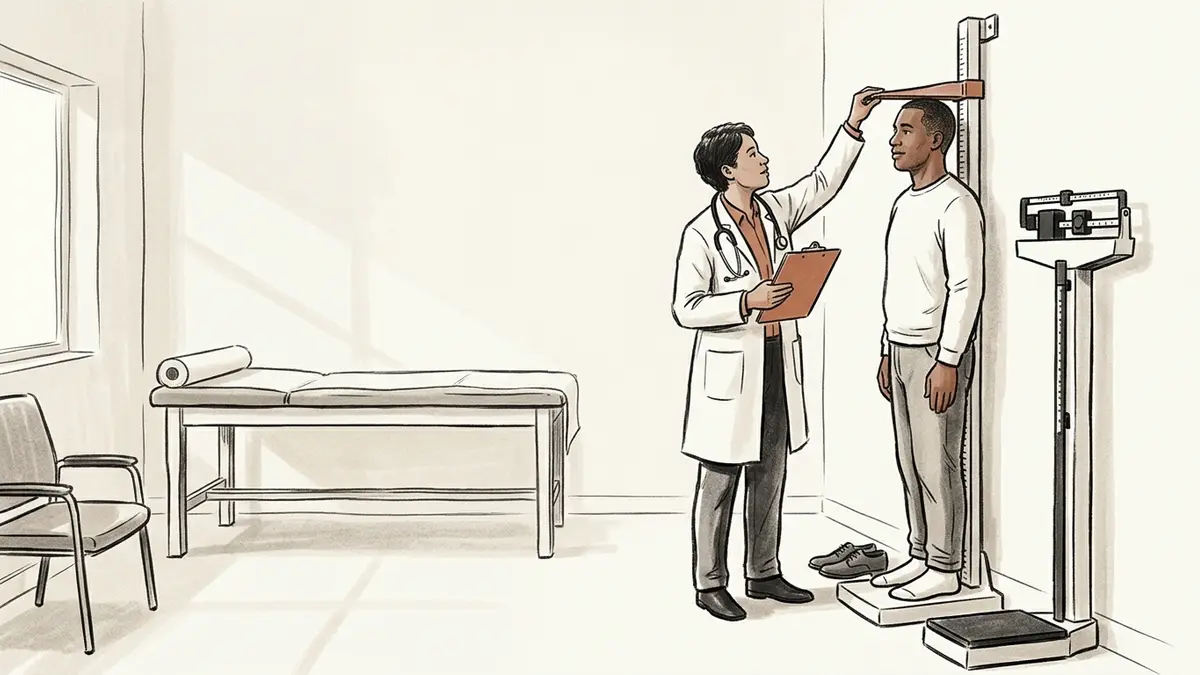
Body Mass Index (BMI) shows up on almost every doctor’s intake form, fitness tracker, and health app. Yet the actual math behind it looks a little strange at first glance. Why do you square your height? Where does the number 703 come from when you use pounds and inches?
At its core, BMI is just a height-to-weight ratio. It estimates whether your weight is proportional to how tall you are. You can check your numbers in seconds with our BMI Calculator, or keep reading to see how the equation works by hand.
The plain-English BMI formulas
BMI was originally created using the metric system, which makes the metric equation the cleanest version. It divides your weight in kilograms by your squared height in meters.
The metric formula: BMI = weight (kg) ÷ height (m)²
If you know your height in centimeters, divide that number by 100 first to get meters. A height of 170 cm becomes 1.70 meters.
In the US, most of us track weight in pounds and height in feet and inches. Rather than converting pounds to kilograms and inches to meters every time, you can use a single conversion constant: 703.
The imperial formula: BMI = (weight in lb ÷ height in inches²) × 703
That 703 isn’t a magic health multiplier. It is just the conversion factor that bridges kilograms per square meter and pounds per square inch. Both equations give you the exact same score.
Why do we square the height?
When people look at how BMI is calculated, the most common question is why height gets multiplied by itself. If you want a ratio of weight to height, why not just divide pounds by inches?
The reason comes down to how human bodies grow in three dimensions. Picture a 6-foot-tall person standing next to a 5-foot-tall person with the exact same body proportions. The 6-foot person isn’t just stretched vertically like a rubber band. Their frame is also wider across the shoulders and deeper from chest to back.
If you only divided weight by height in a straight line, tall people would always score much higher, even if they were completely lean. On the other hand, if you cubed the height to measure full 3D volume, shorter people would skew too high because humans don’t expand equally in all three directions as they get taller.
Belgian mathematician Adolphe Quetelet developed this index in the 1830s after noticing a pattern across large adult populations: body weight naturally scales in proportion to the square of a person’s height. Squaring the height levels the playing field, letting the formula compare a 5-foot-2 person and a 6-foot-4 person on the same scale.
A step-by-step worked example
Let’s run the numbers for someone who weighs 154 pounds (about 70 kilograms) and stands 5 feet 7 inches tall (170 centimeters).
Using the imperial formula:
- Turn the height entirely into inches. Five feet is 60 inches (5 × 12). Add the remaining 7 inches to get 67 inches.
- Square the inches: 67 × 67 = 4,489.
- Divide the weight in pounds by the squared inches: 154 ÷ 4,489 ≈ 0.034306.
- Multiply by 703: 0.034306 × 703 ≈ 24.1.
Using the metric formula:
- Convert centimeters to meters: 170 cm ÷ 100 = 1.70 meters.
- Square the meters: 1.70 × 1.70 = 2.89.
- Divide the weight in kilograms by the squared meters: 70 ÷ 2.89 ≈ 24.2.
Notice the tiny 0.1 gap between the two answers? That happens because 154 pounds isn’t exact to 70 kilograms, and 67 inches is actually 170.18 centimeters. Minor rounding differences like this are normal and don’t change how the score is read.
What the final number means
Once you have your score, the Centers for Disease Control and Prevention (CDC) sorts adult numbers into standard weight categories. These brackets are the same for men and women aged 20 and older.
| BMI Range | CDC Category |
|---|---|
| Less than 18.5 | Underweight |
| 18.5 – 24.9 | Healthy weight |
| 25.0 – 29.9 | Overweight |
| 30.0 – 34.9 | Obese (Class I) |
| 35.0 – 39.9 | Obese (Class II) |
| 40.0 and above | Severe obesity (Class III) |
In our example, a score of 24.1 or 24.2 puts that person inside the 18.5 to 24.9 bracket, which the CDC considers a healthy weight.
Working the math backward to find your healthy weight range
Once you know the formula, you can also run it in reverse. Since the CDC defines a healthy adult BMI as 18.5 to 24.9, you can plug your own height into those boundaries to see your target weight bracket.
To find the bottom of your range in kilograms, multiply 18.5 by your height in meters squared. For the top of your range, multiply 24.9 by your height in meters squared. (Multiply those kilogram numbers by 2.20462 to convert them into pounds.)
Take our 5-foot-7 (1.70 m) example person, whose squared height is 2.89:
- Lower boundary: 18.5 × 2.89 = 53.5 kg (about 117.9 lb)
- Upper boundary: 24.9 × 2.89 = 72.0 kg (about 158.6 lb)
At 5 feet 7 inches, any weight between roughly 118 and 159 pounds lands in the standard healthy bracket. If you want to move your weight toward a specific target, a BMR calculator, TDEE calculator, or calorie calculator can help you figure out your daily energy needs.
What the formula leaves out
Because the BMI equation only looks at total weight and total height, it has a major blind spot: it cannot tell the difference between fat and muscle.
Muscle is dense and heavy. A weightlifter carrying 200 pounds on a 5-foot-10 frame with 10% body fat will still get a BMI of 28.7, which the chart labels “Overweight.” The math doesn’t know that the extra mass is lean tissue. On the flip side, an older adult experiencing sarcopenia—the natural loss of muscle mass with age—might carry excess visceral fat (deep belly fat around the organs) while weighing little enough to score in the “Healthy weight” bracket.
The standard adult chart doesn’t apply to everyone, either. Kids and teens grow at shifting rates, so pediatricians compare their BMI against age- and sex-specific growth percentiles rather than fixed cutoffs. The World Health Organization (WHO) also points out that health risks show up at different thresholds across ethnic backgrounds. Asian adults, for instance, often face higher cardiovascular risks starting at a BMI of 23 instead of 25.
Treat your BMI as a fast, free screening number rather than a final diagnosis. It is a solid starting point to bring to your doctor alongside better context like waist circumference, body composition, and blood work.
To skip the scratchpad math and get your score and target weight range right away, use our BMI Calculator.